

Organizational
Context
What is the Organizational Context
for Social and Emotional Learning?
In order to integrate social and emotional learning (SEL) into the instructional fabric of Residential Environmental Learning Centers (RELCs), it must also be practiced by the organization as a whole on a daily basis. The organizational context for SEL is the ecosystem that supports SEL on a day-to-day basis within all levels of the organization, from the board and administrators to facility staff and field instructors. Instead of focusing on specifics like time with students, out-of-class time for participants, or program and curriculum development, it looks at the context in which these experiences are set. This includes the influence of larger institutional factors, like an organization’s values, culture, operational systems and structures, internal and external communities, and physical environment. Practices that build an intentional culture of equity and inclusion are fundamental to an organizational context that supports SEL outcomes for staff and program participants. Being inclusive of diverse perspectives and lived experiences is critical to running a program that supports SEL for all learners.
Building organizational capacity for SEL requires reflection and feedback on an organizational and individual level. Here are some examples of how the Collaborative for Academic, Social, and Emotional Learning (CASEL) competencies connect to organizational context:

Self-Awareness
The organization accurately perceives how it fits into the communities it serves and its environmental context, as well as the needs that it meets. Staff members are able to not only recognize their emotions, but also have confidence and feel effective in the jobs they are performing. Everyone in the organization is able to clearly communicate its mission, vision, values, and impact.

Self-Management
The organization’s staff are able to set clear goals, with the motivation, organization, and discipline necessary to follow through with them. Staff members are able to act professionally and accomplish their jobs to the best of their abilities.

Social Awareness
The organization understands the diverse communities it serves and has the skills necessary to navigate the complex social and cultural values at play in today’s society in order to create a welcoming and inclusive environment. Individuals within the organization treat one another with respect and respond to situations with empathy. They welcome diversity within their environment and work together to create safe, productive spaces. The organization practices eco-literacy, is aware of its environmental impact, and strives to operate sustainably.

Relationship Skills
The organization places high value on clear communication, teamwork, and personal relationships, both internally with staff, and externally with the students and schools that it serves. It works to understand and hear the many stakeholders with whom it interacts. Staff are given the time to build relationships with one another, maintain open communication channels, and address conflicts in productive ways.

Responsible Decision-Making
The organization actively gathers feedback on its effectiveness from a wide variety of stakeholders. It is able to reflect on and analyze the data from this feedback to remain relevant to those it serves and to create organizational stability. Staff members are encouraged to give and receive feedback in order to facilitate personal growth and to identify and solve problems in ways that contribute to organizational success.
Key Components of Organizational Context
that Support SEL
We have identified six major categories that capture key components related to organizational context:


Each of the six sections below provides case studies, tools, and resources that can help your organization develop its capacity to embody the SEL competencies it wishes to model for the youth it serves. Each section contains a definition of the term, relevant examples from Residential Environmental Education Partnership on SEL (REEP) organizations, reflection questions, and tools for use at your organization. A list of resources that guided the creation of each section can be found at the bottom of the page.
Organizational Identity
Organizational Identity answers the questions “Who are we?”, “What do we stand for?”, and “What do we do?” Learning to embody the mission and core values of an organization promotes employee self-awareness (recognizing individual thoughts and values) and social awareness (through perspective-taking, appreciation for diversity, respect for others, and empathy).




Organizational Structure
Organizational Structure refers to an organization’s operational policies and procedures. An organization with strong organizational structure in relation to SEL competencies supports employee understanding of the expectations and implementation of their roles within the context of organizational values and mission, and offers staff opportunities to grow and develop. Highlighted competencies include self-awareness, self-management, social awareness, and relationship-building.


Intentional Community Culture
Intentional Community Culture demonstrates inclusive relationship-building practices at all levels of the organization. Some examples include internal feedback systems, targeted staff discussions, and program observations with embedded qualitative assessments.




Feedback Systems and Evaluation
Feedback Systems and Evaluation for staff and the organization as a whole can point to any SEL competency. For example, a staff self-evaluation can allow an opportunity to reflect on strengths and areas for growth (self-awareness and self-management), whereas occasional surveys can allow for feedback on procedures and practices in an organization, and allow staff to proffer solutions (responsible decision-making, social awareness and relationship skills).

Training and Professional Development
When discussing “Organizational Context,” it is important to note that SEL should be embedded in training and professional development for staff at all levels and in all roles; i.e. not limited to Field Instructors.
Physical Space
Creating spaces—administrative offices and staff housing, in addition to programming spaces—that are visibly and explicitly inclusive (for example, identifying all-gender restrooms and using signs written in multiple languages) aligns strongly with the SEL domains of social awareness and relationship skills.
Stump Circles
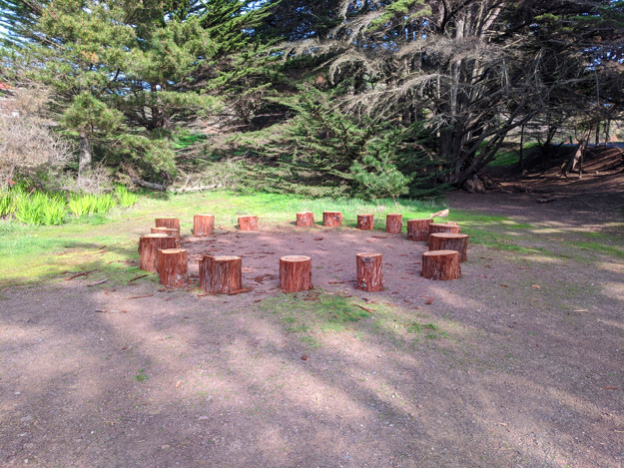
Stump circles are common at RELCs and in other outdoor classrooms. Stump circles are formed with a large ring of tree stump slices of uniform height, generally about one to two feet tall, and wide enough in diameter to offer support as a seat. They are placed in a large circle, with enough seats to accommodate all members of a typical learning or hiking group at that site. They can serve as gathering spots for group check-ins, a lesson, or other group discussion. Stump circles allow for group conversation, supporting contributions by all members of the group. Additionally, by providing natural places to sit, programs can support students who may not be comfortable sitting on the ground, while still helping them develop a connection to nature and establish a sense of place.