Overview
Social and Emotional Learning & Residential Environmental Learning Centers
While there exist several leading frameworks and theories related to youth’s development of the skills and attitudes necessary for success in school, work, and life, social and emotional learning (SEL) is a term that has gained popularity and use in recent years, particularly in formal education. It is just as relevant in the setting of Residential Environmental Learning Centers (RELCs), which often serve as an extension of classroom programming. Furthermore, RELCs make a significant contribution to the field by expanding the context of SEL to include the rest of the natural world.
For the field of residential environmental education (EE) to remain relevant, it is essential that we develop an understanding of SEL, strive to incorporate research-based best practices, and articulate RELCs’ unique value and contribution to the growing awareness of how best to support young people’s development.
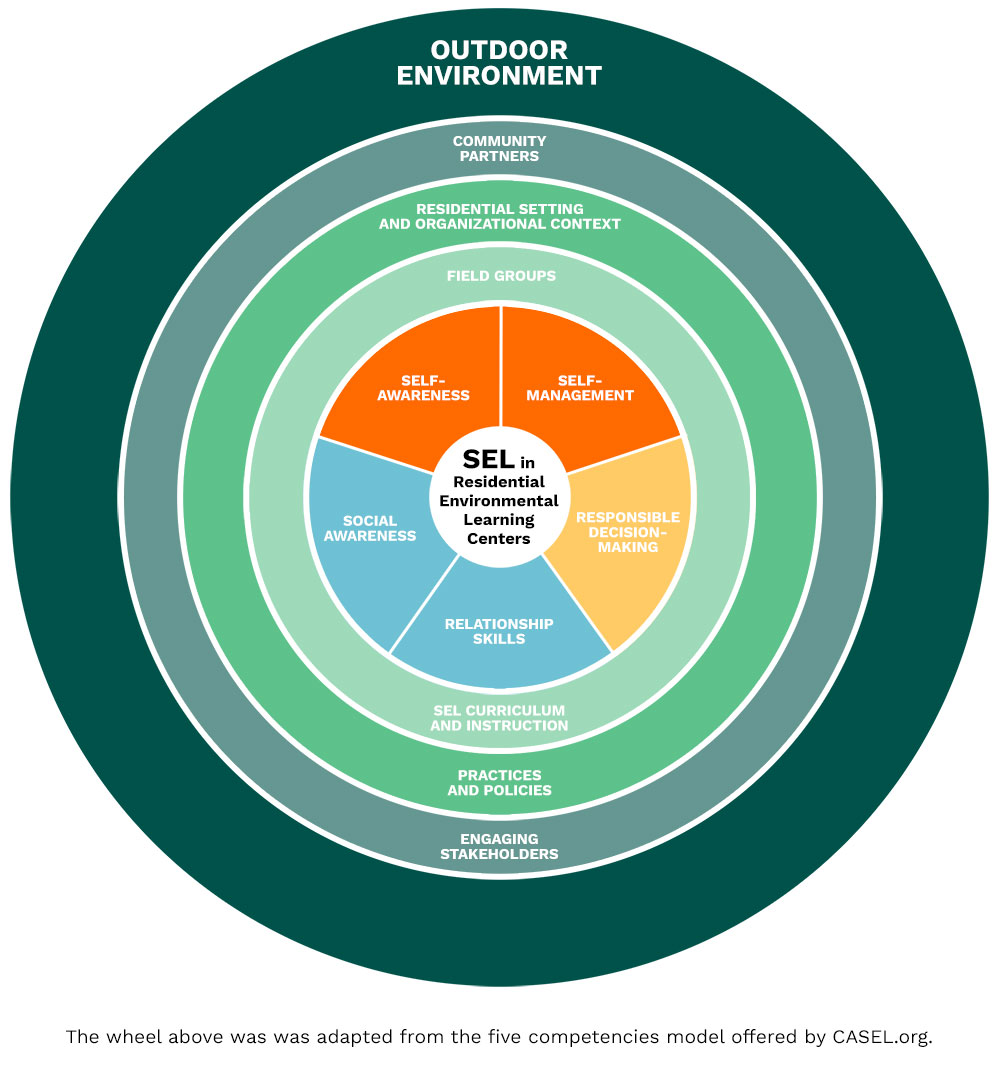
Click wheel to view larger
Why RELCs?
RELC settings are conducive to developing students’ self-confidence, communication skills, and responsible decision-making, along with other SEL-related outcomes. Click here to learn about the RELC partnership that created this website. In addition to the opportunities for supporting SEL during field practice, in the residential setting, and by systems embedded into organizational context, all of which are addressed in this toolkit, there exist two additional foundational components conducive to social and emotional growth that are unique to the RELC environment: a novel learning environment in a natural setting.

Novel Environment
The very act of leaving home and a familiar classroom significantly alters the learning environment, while at the same time facilitating new perspectives on learning, relationships, and day-to-day life. This novel learning environment offers the opportunity for students to better understand themselves, and reimagine their relationships to peers and teachers. Students who struggle in the classroom setting often shine at RELCs, demonstrating competencies unseen in the classroom, which provides them with critical experience in building a positive identity as a learner. Likewise, learning, eating, and sleeping in shared accommodations outside of the classroom allows students to build social awareness, find commonalities with peers, break up negative social dynamics that may exist in the classroom or school environment, and strengthen relationships through shared experiences. Program elements that include collaborative group work, scientific investigations, scaffolded physical challenges, and opportunities to reflect contribute to the positive impact on social and emotional development.
Natural Setting
Numerous studies support the concept of humans’ innate connection and affinity to the natural world (Wilson, 1984; Rozak, 1992; Orr, 2004); many others promote the benefits of time spent outdoors (Gill, 2014), from positive impacts on health and wellness to demonstration of more productive behaviors, including better self-control and fewer problematic or disruptive behaviors. Richard Louv, who introduced the concept of “nature-deficit disorder,” describes the costs of disconnection from nature as “diminished use of the senses, attention difficulties, higher rates of physical and emotional illnesses, a rising rate of myopia, child and adult obesity, and Vitamin D deficiency, among other maladies” (Suttie, 2016). Even medical doctors are increasingly prescribing time in nature for stress reduction, attention restoration, weight reduction, reduced blood pressure, and a host of other benefits (Klass, 2016).
Today’s kids spend less time outdoors than previous generations, however, and there is growing concern about the long-term impacts on youth and the ecosphere as a result of this disconnection—or even alienation—from nature. RELCs offer a rich environment for youth and adults to connect (or reconnect) to nature through both structured and unstructured learning environments. Field instructors skillfully guide students to connect to nature through modeling, intentionally sequenced activities, and free-choice time to explore and play in nature. RELCs create safe opportunities for students to observe, reflect, contemplate, and interact with the natural world in order to develop authentic and positive connections to nature, which might be expressed as seeing the beauty in the sunrise, feeling a sense of contentment listening to a babbling stream, breathing in the scent of a pine forest, or having fun with friends while investigating the mineral composition of sand on the beach.

Why Now?
This work could not be more important or timely; educational experts agree that social and emotional skills are essential to success in school, the workplace, and in life (Durlak et al., 2011).
While nearly 50% of RELCs around the country list program outcomes related to development of skills such as teamwork and leadership (Ardoin et al., 2015), as a field, we have lacked a common message or purpose for those claims. In the early stages of toolkit development, conversations with program leaders indicated that few sites, if any, were intentionally supporting SEL, and rarely was this done from a research-based approach.
Many SEL leaders now call for a more integrated approach, because all learning is social and emotional.
Consider that students typically attend a RELC for three to five days. Each day presents the potential for sustained immersive focus on experiences that build SEL skills. When one considers the estimated 300-500 residential EE organizations across the nation, the potential to positively impact over 1,000,000 students served annually by our field is tremendous.