

About Us
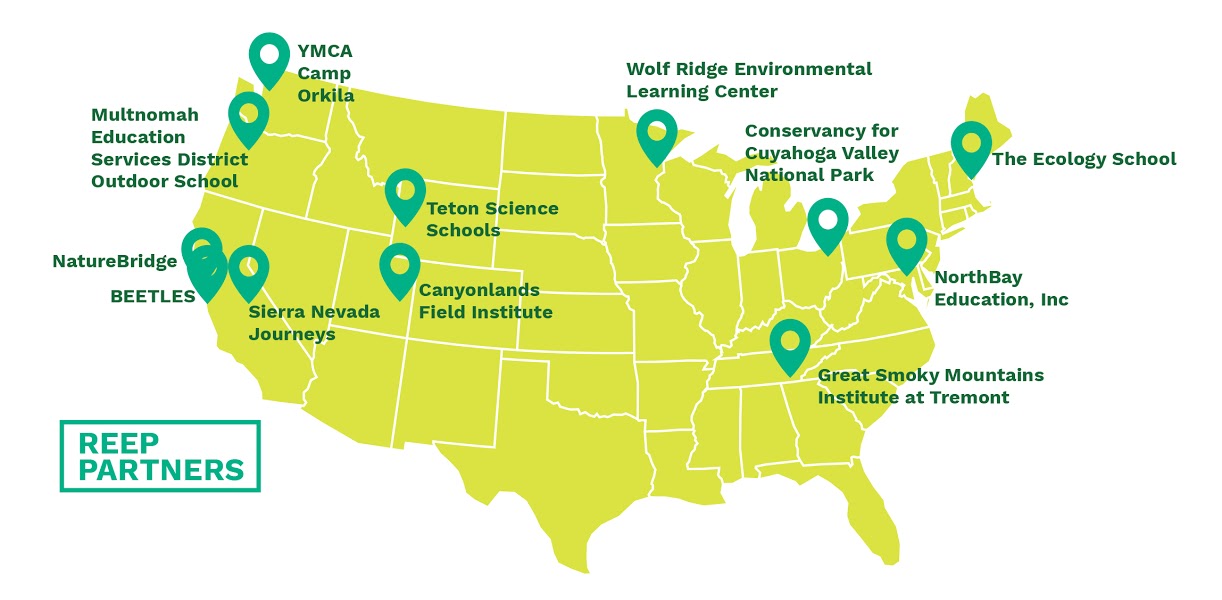

REEP Organizations

BEETLES (a project of Lawrence Hall of Science at UC Berkeley) – Emilie Lygren and Craig Strang

Canyonlands Field Institute – Karla VanderZanden and Kori Donley (now with Westminster Woods)
Conservancy for Cuyahoga Valley National Park – Amanda Schuster and Katie Wright

The Ecology School – Alexandra Grindle and Drew Dumsch
Great Smoky Mountains Institute at Tremont – John DiDiego and Logan Rosenberg

Multnomah Education Service District Outdoor School – Andrea Hussey and Jennifer Basham

NatureBridge – Stephen Streufert, Kathleen O’Connor, and Estrella Risinger (now with AEOE)

NorthBay Education, Inc. – Dave Dahl and Kathy Chambliss (with support from Keith Williams and Richard Garber)

Sierra Nevada Journeys – Jen Kopnicky and Sean Hill (with support from Jennifer Robinson)

Teton Science Schools – Colby Mitchell and Kevin Krasnow

Wolf Ridge Environmental Learning Center – Shannon Walz and Danielle Hefferan

YMCA Camp Orkila – Christy Shiers and Haley Cruz Winchell (with support from Maureen Bowler)
A number of other valuable individuals and organizations consulted on this project. They include:
-
Learning for Action: Facilitators Steven LaFrance, Jessica Xiomara García, Monica Griffith
-
S. D. Bechtel, Jr. Foundation: Senior Program Officer Alex Hooker and Associate Program Officer Alexis Llamas
-
Stanford University, Graduate School of Education and Woods Institute for the Environment Project leads: Dr. Nicole Ardoin, Dr. Mele Wheaton, and Emily Williams worked alongside the REEP group, conducting a year-long research study to better understand SEL in residential EE titled “Social-Emotional Learning & Residential Environmental Education: Analyzing the Connections and Measuring the Benefits”
-
Center for Diversity and the Environment: Gladys Ruíz, consultant
-
Moab Valley Multicultural Center
